
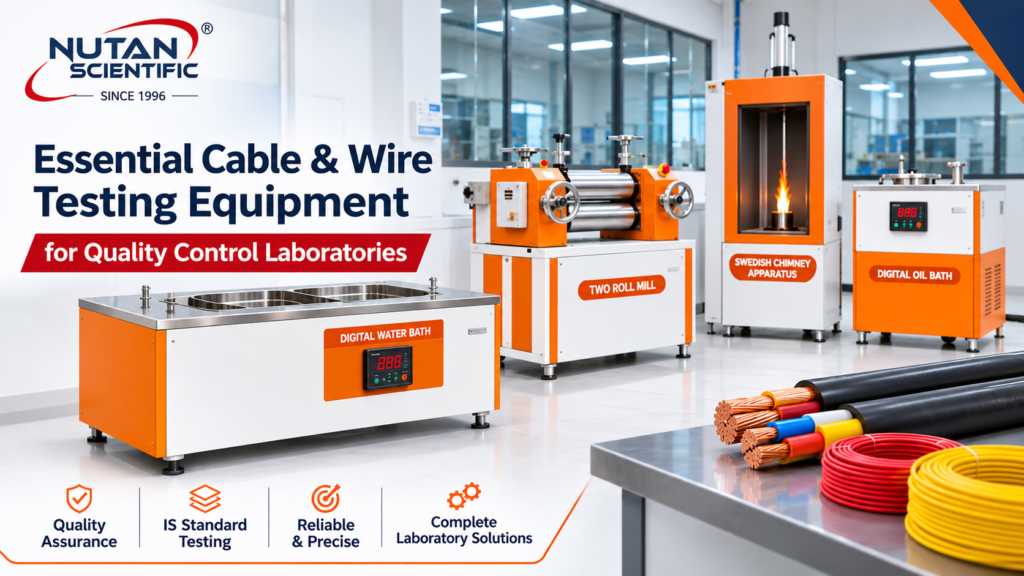
An Essential Guide for Cable Manufacturers, Testing Laboratories, and Quality Assurance Professionals
Introduction: Building Quality into Every Cable
In the modern electrical industry, cables and wires are essential components of residential, commercial, and industrial infrastructure. From household electrical installations to large-scale power transmission networks, the performance and safety of electrical systems depend significantly on the quality of the cables used.
For cable and wire manufacturers, maintaining consistent product quality is not just a manufacturing objective—it is a critical responsibility.
This is where a properly equipped Cable and Wire Testing Laboratory plays an important role.
A quality control laboratory enables manufacturers to evaluate the electrical, mechanical, physical, and thermal properties of cables and their constituent materials. Through systematic testing, manufacturers can identify potential defects, verify product specifications, and support compliance with applicable Indian Standards (IS) and international standards.
However, the effectiveness of any laboratory depends on the selection of suitable testing equipment.
At Nutan Scientific, we specialize in manufacturing scientific and industrial testing equipment, including instruments designed for cable and wire testing applications.
With industry experience dating back to 1996, we understand the importance of dependable testing instruments in maintaining consistent manufacturing quality.
In this guide, we explore the essential cable and wire testing equipment used in quality control laboratories, their applications, and the factors manufacturers should consider when selecting instruments.
1. Why Every Cable Manufacturer Needs a Quality Control Laboratory
Cable manufacturing involves several processes, including conductor preparation, insulation extrusion, sheathing, and final product inspection.
During these stages, variations in raw materials, processing temperatures, manufacturing conditions, and equipment settings can influence the properties of finished cables.
A dedicated testing laboratory helps manufacturers monitor these variations and maintain product quality.
Key Benefits of a Cable Testing Laboratory
Consistent Product Quality
Regular testing helps identify variations in material properties and finished cable characteristics, supporting better consistency across production batches.
Compliance with Applicable Standards
Testing laboratories help manufacturers evaluate products against the requirements of relevant standards, including IS 694, IS 1554, IS 7098, and other applicable specifications.
Early Detection of Manufacturing Defects
Laboratory testing can help detect issues involving insulation properties, conductor characteristics, mechanical strength, and material performance.
Reduced Product Rejection
Identifying defects before final dispatch can help manufacturers reduce avoidable rework, customer complaints, and rejected batches.
Improved Customer Confidence
A structured quality control process supported by documented testing results helps demonstrate a manufacturer’s commitment to product reliability.
For these reasons, investing in suitable cable and wire testing equipment is an important step toward establishing an effective quality assurance system.
2. Essential Cable and Wire Testing Equipment for Quality Control Laboratories
Different cable types require different testing procedures. The instruments needed for a laboratory depend on the products being manufactured, their voltage ratings, insulation materials, and applicable testing standards.
Below are some important categories of equipment commonly used in cable and wire testing laboratories.
2.1 Universal Tensile Testing Machine
<text_placeholder: Insert original Nutan Scientific tensile testing machine image, if available.>
A Universal Tensile Testing Machine is used to evaluate the mechanical properties of suitable cable materials and specimens.
Mechanical testing is particularly important for assessing the strength and elongation characteristics of insulation and sheath compounds.
Key Applications:
- Tensile strength testing of insulation materials.
- Elongation at break testing.
- Evaluation of mechanical properties before and after specified ageing procedures.
- Quality control of polymer and rubber-based cable compounds.
Why It Matters:
Insulation and sheathing materials must possess appropriate mechanical properties to withstand handling, installation, and service conditions.
A suitable tensile testing machine helps laboratories evaluate these characteristics according to applicable test methods.
2.2 Digital Water Bath
A Digital Water Bath is an important laboratory instrument used to maintain controlled water-temperature conditions.
In cable and wire testing, controlled temperature environments may be required for specimen conditioning and certain specified test procedures.
Key Applications:
- Temperature-controlled specimen conditioning.
- Laboratory processes requiring defined water temperatures.
- Applicable cable material and product testing procedures.
- Supporting consistent laboratory testing conditions.
Why It Matters:
Temperature variations can influence material behavior and test results. A suitable Digital Water Bath helps laboratories maintain controlled conditions during relevant procedures.
Nutan Scientific manufactures Digital Water Baths for industrial and laboratory testing applications.
2.3 Hot Set Test Apparatus
Hot Set Testing is an important procedure used to evaluate the behavior of suitable cross-linked insulation materials at elevated temperatures under a specified load.
The test helps assess elongation during heating and permanent deformation after cooling, according to the applicable method.
Key Applications:
- Testing cross-linked insulation materials.
- Evaluating elongation under specified thermal and mechanical conditions.
- Assessing permanent set after the prescribed test cycle.
- Supporting quality control of XLPE and other applicable cross-linked compounds.
Why It Matters:
Cross-linked cable insulation must exhibit appropriate performance under elevated-temperature conditions.
Hot Set Testing provides useful information about the behavior of these materials when subjected to defined test conditions.
2.4 Two Roll Mill
A Two Roll Mill is widely used in polymer and rubber processing laboratories for mixing and preparing material compounds.
In cable manufacturing, the properties of insulation and sheathing compounds significantly influence final product performance.
Key Applications:
- Mixing polymer and rubber compounds.
- Laboratory-scale material blending.
- Preparation of suitable test compounds.
- Research and development of insulation and sheath materials.
- Material evaluation and process development.
Why It Matters:
Consistent material preparation is important for meaningful laboratory evaluation.
A Two Roll Mill supports controlled mixing and processing of suitable compounds before further testing.
Nutan Scientific offers Two Roll Mill equipment for laboratory and industrial material-processing requirements.
2.5 Digital Oil Bath
A Digital Oil Bath provides controlled heating through an appropriate oil medium.
It is used in laboratory applications requiring controlled temperatures within the equipment’s specified operating range.
Key Applications:
- Controlled heating of suitable laboratory specimens.
- Material conditioning where an oil bath is specified.
- Laboratory processes requiring a stable heating medium.
- Application-specific thermal testing procedures.
Why It Matters:
Accurate temperature control is essential for laboratory procedures in which thermal conditions influence material behavior.
A suitable Digital Oil Bath helps maintain the required heating conditions for the intended application.
Nutan Scientific manufactures Digital Oil Baths for scientific and industrial laboratory applications.
2.6 Swedish Chimney Apparatus
Fire-related testing is an important consideration in the cable and wire industry, particularly for applications where flame propagation characteristics must be evaluated.
The Swedish Chimney Apparatus is associated with specific cable flame propagation test arrangements.
Key Applications:
- Evaluating flame propagation characteristics under applicable methods.
- Assessing burning behavior of suitable cable specimens.
- Supporting fire-performance testing in cable laboratories.
- Testing according to the specified apparatus configuration and procedure.
Why It Matters:
The fire performance of cables is an important aspect of electrical safety.
Suitable flame testing equipment enables laboratories to evaluate specified fire-related properties under controlled test conditions.
Nutan Scientific manufactures Swedish Chimney Apparatus equipment for relevant cable testing applications.
2.7 Insulation Resistance Testing Equipment
Insulation resistance testing is an important part of evaluating electrical insulation performance.
The test measures the resistance offered by insulation to electrical current under specified conditions.
Key Applications:
- Insulation resistance measurement.
- Evaluation of insulation quality.
- Electrical quality control of finished cables.
- Testing under applicable voltage and temperature conditions.
Why It Matters:
Insulation performance is essential for electrical safety and dependable cable operation.
Appropriate insulation resistance testing equipment helps manufacturers assess this important electrical characteristic.
2.8 High Voltage Testing Equipment
High voltage testing equipment is used to assess whether cable insulation can withstand a specified test voltage under defined conditions.
The exact testing arrangement depends on the cable category, rated voltage, and applicable standard.
Key Applications:
- Voltage withstand testing.
- Electrical insulation evaluation.
- Finished cable quality verification.
- Testing according to relevant product specifications.
Why It Matters:
Voltage withstand testing is an important element of electrical quality assurance.
Suitable equipment helps laboratories perform prescribed tests and identify certain insulation defects.
2.9 Ageing Oven
An Ageing Oven is used to expose suitable test specimens to controlled elevated temperatures for specified durations.
Thermal ageing tests help evaluate changes in material properties after exposure to prescribed heating conditions.
Key Applications:
- Thermal ageing of insulation materials.
- Ageing of cable sheath compounds.
- Preparation of specimens for post-ageing mechanical tests.
- Evaluation of changes in tensile strength and elongation.
Why It Matters:
The behavior of cable materials after thermal exposure is an important consideration in quality control.
Ageing ovens support standardized laboratory procedures for evaluating these changes.
3. Understanding IS Standards for Cable and Wire Testing
Indian Standards provide technical requirements for various types of cables and conductors.
Manufacturers must identify the applicable standards based on their products and intended applications.
Some important Indian Standards include:
| IS Standard | Description |
|---|---|
| IS 694 | PVC insulated cables for working voltages up to and including 1100 V |
| IS 1554 | PVC insulated heavy-duty electric cables |
| IS 7098 | Cross-linked polyethylene insulated cables |
| IS 398 | Aluminium conductors for overhead transmission |
| IS 14255 | Aerial bunched cables for working voltages up to and including 1100 V |
These standards contain different requirements depending on the product category and relevant part.
Specific test methods may also be referenced through other Indian or international standards.
Important: No single instrument can perform every test required under these standards.
A laboratory must select the appropriate equipment for each applicable test clause, considering the required measurement range, test conditions, and specimen characteristics.
Nutan Scientific supports manufacturers and laboratories in identifying testing equipment suited to their specified requirements.
4. How to Select the Right Cable Testing Equipment
Choosing the correct equipment is one of the most important decisions when establishing or upgrading a cable testing laboratory.
Manufacturers should consider several factors before purchasing instruments.
Identify Your Cable Manufacturing Category
Different cable types require different testing arrangements.
For example, a manufacturer producing PVC insulated building wires may have different laboratory requirements from a manufacturer producing XLPE power cables or overhead conductors.
Understanding the product category helps determine the necessary testing instruments.
Review Applicable Testing Standards
Equipment selection should begin with a review of the relevant standard, its current applicable edition, and specific test requirements.
This helps ensure that the selected instrument has the appropriate capabilities and configuration.
Evaluate Equipment Specifications
Important factors may include:
- Measurement range and resolution.
- Temperature control capabilities.
- Equipment dimensions and specimen capacity.
- Test load and operating conditions.
- Applicable test method requirements.
- Calibration and maintenance needs.
- Laboratory space and utility requirements.
Consider Long-Term Laboratory Requirements
Manufacturers planning to expand their product range should consider whether their laboratory may require additional instruments or testing capabilities in the future.
Choose an Experienced Equipment Manufacturer
Working with a manufacturer familiar with industrial testing applications can simplify equipment selection and help address application-specific requirements.
An experienced supplier can also provide guidance regarding suitable configurations, installation, operation, and maintenance.
5. How Nutan Scientific Supports Cable Testing Laboratories
At Nutan Scientific, we understand that every laboratory has unique technical and operational requirements.
Established in 1996, our company manufactures scientific and industrial testing equipment for a range of laboratory applications.
Our cable and wire testing solutions are developed with attention to practical engineering requirements and applicable testing procedures.
A Wide Range of Testing Equipment
Our product portfolio includes equipment for thermal testing, material preparation, flame-related testing, and other laboratory applications.
This allows customers to explore different instruments for their testing requirements.
Equipment for IS and International Test Methods
We manufacture equipment intended to support applicable Indian Standard test methods and specified international testing requirements.
The suitability of each instrument is determined by its technical specifications and the relevant testing procedure.
Customized Manufacturing Solutions
Laboratories may require different equipment dimensions, capacities, operating ranges, or configurations.
Nutan Scientific provides customized equipment solutions based on technical requirements and manufacturing feasibility.
Installation and Technical Assistance
Proper equipment installation and operation are important for laboratory performance.
Our team supports customers with equipment-related technical guidance and after-sales assistance according to the supplied equipment and agreed service scope.
Focus on Practical Laboratory Requirements
Our objective is to provide testing equipment that helps manufacturers carry out their quality control activities with consistency and confidence.
6. Common Mistakes to Avoid When Setting Up a Cable Testing Laboratory
A laboratory can face operational challenges when equipment is purchased without proper planning.
Some common mistakes include:
Selecting Equipment Without Reviewing Test Standards
An instrument may appear suitable but lack the specific configuration required by an applicable test method.
Ignoring Calibration Requirements
Testing equipment must be calibrated and maintained appropriately to support reliable measurements.
Choosing Equipment Based Only on Price
Initial purchase cost is important, but manufacturers should also evaluate technical suitability, construction, serviceability, and long-term operating requirements.
Insufficient Laboratory Planning
Equipment installation may require specific electrical connections, ventilation, temperature control, or laboratory space.
Overlooking Operator Training
Even suitable testing equipment can produce unreliable results if the test procedure is not followed correctly.
Avoiding these mistakes helps manufacturers establish more effective and dependable quality control laboratories.
7. The Future of Cable and Wire Quality Control
The cable and wire industry continues to evolve as electrical infrastructure, industrial automation, renewable energy, and power distribution systems develop.
These applications place increasing importance on material quality, product reliability, and consistent manufacturing processes.
For manufacturers, this makes effective quality control increasingly valuable.
Investing in suitable testing instruments, maintaining documented procedures, and adopting systematic laboratory practices can help businesses strengthen their manufacturing operations.
At Nutan Scientific, we aim to support these requirements by providing practical testing equipment solutions for the cable and wire industry.
Conclusion: Build a Stronger Quality Control Laboratory with Nutan Scientific
A well-equipped cable and wire testing laboratory is an essential part of a dependable manufacturing operation.
From evaluating mechanical strength and thermal performance to assessing electrical insulation and flame propagation characteristics, each testing instrument contributes to a specific aspect of product quality verification.
Selecting the right equipment helps manufacturers improve consistency, identify potential defects, and support compliance with applicable technical standards.
Nutan Scientific is committed to supporting cable and wire manufacturers with reliable, application-focused testing equipment.
With manufacturing experience dating back to 1996, we understand the importance of practical engineering, appropriate instrument selection, and dependable technical support.
Whether you are establishing a new quality control laboratory, expanding your testing capabilities, or replacing existing equipment, choosing suitable instruments is an important investment in your manufacturing quality.
Looking to Set Up or Upgrade Your Cable and Wire Testing Laboratory?
Partner with Nutan Scientific for your cable and wire testing equipment requirements.
Explore our range of laboratory testing instruments and discuss your technical specifications with our team.
Nutan Scientific Pvt. Ltd.
Scientific & Industrial Testing Equipment Manufacturer Since 1996
Website: https://nutanscientific.com
Contact our team today to discuss your laboratory equipment requirements and request a quotation.
Frequently Asked Questions (FAQs)
1. What equipment is required for a cable and wire testing laboratory?
The required equipment depends on the cable types and applicable standards. Common instruments include tensile testing machines, insulation resistance testers, high voltage testing equipment, hot set apparatus, ageing ovens, and temperature-controlled laboratory equipment.
2. Why is cable testing important in manufacturing?
Cable testing helps manufacturers evaluate product properties, identify defects, maintain consistent quality, and verify compliance with applicable technical requirements.
3. Which Indian Standards are commonly used for cable testing?
Common standards include IS 694, IS 1554, IS 7098, IS 398, and IS 14255. The applicable standard depends on the type and construction of the cable or conductor.
4. Does Nutan Scientific manufacture cable and wire testing equipment?
Yes. Nutan Scientific manufactures scientific and industrial testing equipment, including instruments intended for cable and wire testing applications.
5. Can cable testing equipment be customized?
Yes. Depending on technical feasibility, equipment can be configured for specific dimensions, operating parameters, capacities, and laboratory requirements.
6. How do I choose the right testing equipment manufacturer?
Consider the manufacturer’s experience, equipment specifications, compatibility with applicable testing methods, customization capabilities, and technical support.
7. Can one testing machine perform all cable tests?
No. Cable testing involves different electrical, mechanical, physical, thermal, and fire-related tests. Each test requires equipment appropriate to the specified method.